
By Matt Taylor | Everyday Treasure Hunter
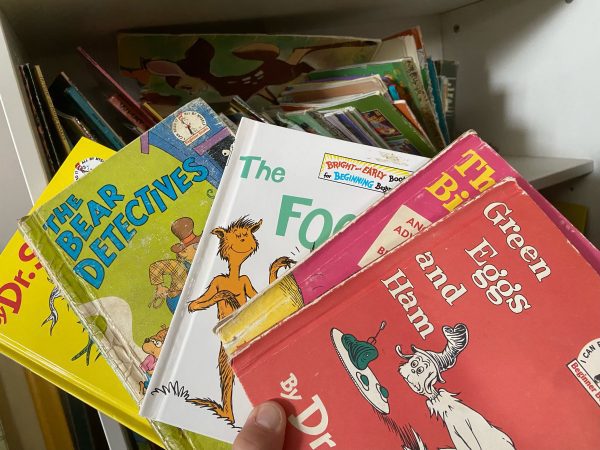
There is a specific kind of adrenaline that hits when you spot a matte, slightly faded spine of a Dr. Seuss book tucked between a “Chicken Soup for the Soul” and a 2012 diet book. As a carpenter by trade, I’m used to measuring twice and cutting once. In the reselling game, if you don’t measure the “points of issue” on a Seuss book twice, you’re the one who gets cut—usually right in the wallet.
I once thought I hit the jackpot. I found a copy of Horton Hears a Who—the color was that perfect, muted 1950s hue, the boards felt right, and it looked like it had lived through six decades of bedtime stories. I reached for it like it was a gold bar. Then I opened the cover. Right there, staring back at me like a taunt, was a “65th Anniversary” sticker. It was just a beat-up modern reprint designed to look old. It’s a heartbreak every “Everyday Hunter” knows: the difference between a $5,000 true first edition and a $5 thrift store dud is often a single line of text or a specific logo.
The 2026 Fast-Check: Is My Dr. Seuss Book a First Edition?
To identify a true Dr. Seuss first edition, the most reliable “tell” is the dust jacket price (e.g., “200/200” for The Cat in the Hat). Without a jacket, you must look for “First Printing” stated on the copyright page or check for the “Younger & Hirsch” points of issue, such as matte boards instead of glossy, or a specific list of “other titles” on the back cover that does not include books published after the current title’s release year.
The 5-Second Scan: How to Spot a Reprint from Across the Room
Before you even pull the book off the shelf, your “Hunter’s Instinct” should be tingling. In my experience, if the book is ultra-glossy or has a barcode on the back cover, keep walking.
True 1st editions from the “Golden Age” (1937–1970s) usually have matte paper boards. If it feels like plastic, it’s likely a modern reprint or a library binding.
The “Back Cover” Rule
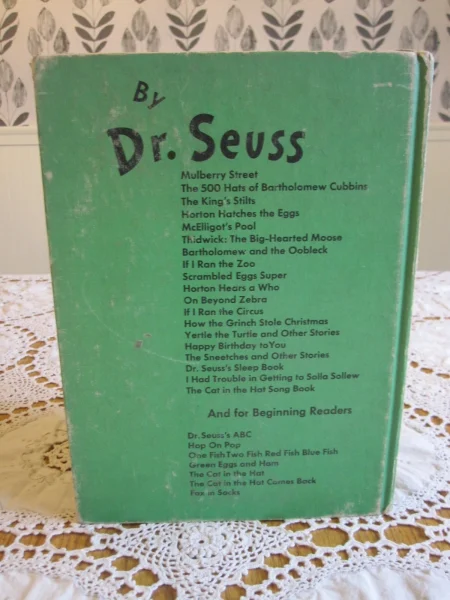
This is the easiest way to debunk a “fake” first edition. Flip the book over. Look at the list of “Other Books by Dr. Seuss.”
- The Rule: If the list includes books that were written after the book you are holding, it is a reprint.
- Example: If you have a copy of The Cat in the Hat (1957) but the back cover lists The Lorax (1971), you’ve got a reprint. A true first edition is a “time capsule”—it can’t know the future.
The Hunter’s Toolkit: Essential Gear
To catch the details others miss, you need the right “trade tools.” Here’s what I keep in my truck:
- A High-Lumen Flashlight: Essential for seeing “blind stamps” on back covers in dark thrift store corners.
- Digital Calipers: To measure board thickness (a key Younger & Hirsch point).
- Archival-Safe Storage Bags: Don’t let a $500 find get ruined by a coffee spill on the way home.
The “Younger & Hirsch” Secret: Technical Points of Issue
If you want to play in the big leagues, you need to know Younger & Hirsch. They wrote the “Know it all guide” of Seuss collecting (First Editions of Dr. Seuss Books). Here is what I look for when I’m checking under the hood:
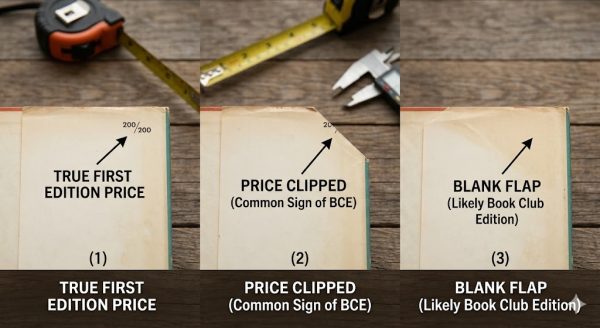
1. The “Price Flap”
If the dust jacket is present, look at the top corner of the front flap. Collectors look for specific price codes:
- 200/200: Original price of $2.00.
- 195/195: Original price of $1.95.
- No Price? If the flap is blank or “clipped” (cut at an angle), it’s almost certainly a Book Club Edition (BCE). While these are great reading copies, they rarely hold high resale value.
2. The “Cat in the Hat” Logo Check
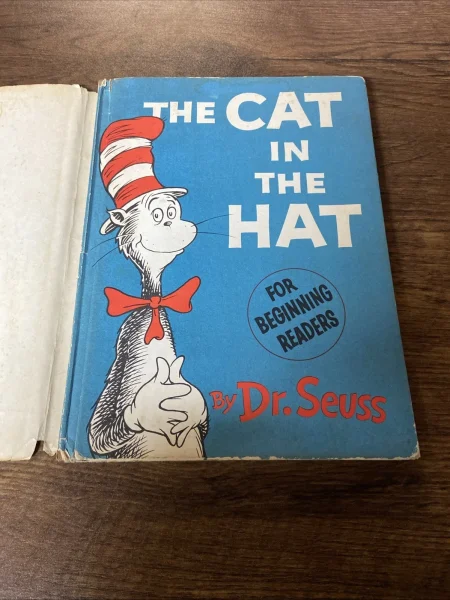
When I see a Cat in the Hat, I immediately look at the front cover for the Beginner Books logo.
- True 1st Issue: Features a “diagonal text” circle that says “FOR BEGINNING READERS.”
- Later Issues (Post-1958): Feature the familiar circular logo with the Cat’s head and the words “I Can Read It All By Myself.”
3. The “Single Signature” Binding
As a carpenter, I appreciate how things are built. Early Seuss books were “single signature”—meaning all the pages are sewn into one big chunk. If you look at the top of the spine (the “head”), you should see one solid group of pages. Later reprints use multiple “signatures” (bundles of pages), which makes the book thicker and more durable, but less valuable.
Comparison: True First Edition vs. Book Club vs. Modern Reprint
| Feature | True First Edition | Book Club Edition (BCE) | Modern Reprint (65th Anniv.) |
| Dust Jacket Price | “200/200” or “195/195” | Blank or “Price Clipped” | Barcode / $15.00+ |
| Cover Finish | Matte Paper / Cloth | Matte or Semi-Gloss | High-Gloss / Laminate |
| Back Board | Clean or “Blind Stamp” | Often has a small indented square | Barcode & ISBN |
| Inner Flap | Full Author Bio | Short or no bio | Promotional ads |
The Unpopular Opinion: Why the “Money” Isn’t Just in the Books
Here’s where I might lose some purists. The books are the foundation, but if you’re a real Hunter, you need to look at the Dr. Seuss “Materia.” I’m talking about original artwork, promotional displays, and vintage memorabilia. While everyone else is fighting over a beat-up copy of Green Eggs and Ham, I’m looking for the 1960s “Cat in the Hat” hand puppets or authorized limited-edition lithographs. The “Everyday Treasure Hunter” knows that the book market is crowded, but the Seuss Artwork market is where the high-margin “flips” live.
If you see something Dr. Seuss that isn’t a book—buy it first, ask questions later.
The “Horton” Trap: Avoiding Modern “Vintage-Look” Reprints
Don’t be like me with that 65th-anniversary Horton. Modern publishers love nostalgia. They intentionally use “flat” colors and old-school fonts to trick the eye.
The Five-Step “Thrift Shop Scan”:
- Check the Gutter: Look for an alphanumeric code (like “A-B-C”). If it’s there, it’s a Book Club or a later printing.
- The “Blind Stamp”: Feel the bottom right corner of the back cover. If you feel a small indented circle or square, it’s a Book Club edition.
- The Copyright Page: Does it say “First Printing”? Note: Some Seuss books don’t say this on the 1st, but they will list later dates on the reprints.
- The “Carpenter’s Eye”: Look at the wear. Real 1950s wear looks like “foxing” (brown spots). Modern wear looks like “scuffs.”
- The “Smell” Test: (Don’t laugh). Old paper has a distinct vanilla/almond scent from the breakdown of lignin. New reprints smell like chemicals and glue.
The Hunter’s Toolkit: Shipping & Presentation
Once you find that rare Seuss, don’t kill the value with bad shipping.
- Cardboard “Sandwich” Inserts: Never ship a rare book in just a bubble mailer.
- Acid-Free Tissue Paper: Protect the dust jacket from “bleeding” during transit.
- The “Double Box” Method: For anything over $500, a box inside a box is the only way to go.
What’s Next?
Identifying the book is only half the battle. Now that you know how to spot a “true” first, you need to know how to value it and get it to the buyer safely.
Check out my other “Everyday Hunter” guides to level up your reselling game:
- 6 eBay Tweaks to Double Your Sales This Month
- The Master Guide to Shipping Glass (Without the Heartbreak)
- Top 10 Most Valuable Dr. Seuss Books (The High-Value List)
Happy hunting, and remember: look under the cover!